


Ever feel like your period has a mind of its own?
One month it’s early, the next it’s late, and the symptoms can range from mildly annoying to completely debilitating.
But here’s something we don’t talk about enough:
Your menstrual cycle is one of the best windows into your hormone health.
It’s like a monthly report card from your body — and if you know how to read it, it can tell you a lot about what’s going on under the surface.
Let’s break it down symptom by symptom, hormone by hormone, and help you figure out whether your cycle is whispering — or shouting — for support.
Key Takeaways
Whether you’re trying to get pregnant, managing a diagnosis like PCOS or endometriosis, or simply want your cycle to stop running your life, your period is the fastest way to find out what your hormones are actually doing.
Table of Contents
Your hormones aren’t working against you — they’re trying to communicate with you. Each month, your cycle is orchestrated by a core cast of hormones, rising and falling in a delicate rhythm. Let’s meet the major players and what they actually do for you.
Nickname: The Builder
When it peaks: First half of your cycle (follicular phase, before ovulation)
What it does:
Too much? Can lead to heavy periods, PMS, breast tenderness, weight gain, and mood swings.
Too little? Can cause light or missing periods, vaginal dryness, low libido, and fatigue.
Estrogen is your radiance hormone — but without balance, it can become the drama queen of the cycle.
Nickname: The Calmer
When it peaks: After ovulation (luteal phase)
What it does:
Too little? You might experience breast tenderness, PMS, short cycles, anxiety, spotting, or trouble conceiving.
Too much? Rare, but can make you feel sluggish or bloated.
Progesterone is like your cycle’s chill pill — if you’re feeling edgy or emotional before your period, this one might be low.
Nickname: The Ovulation Trigger
When it peaks: Mid-cycle — right before ovulation
What it does:
Fun fact: LH is the hormone measured by ovulation test strips (OPKs) to predict your fertile window.
Nickname: The Egg Whisperer
When it peaks: Early in your cycle
What it does:
Too high? Can be a sign of perimenopause or ovarian issues like premature ovarian failure.
Too low? May lead to irregular or missing periods.
Nickname: The Spark
What it does:
Too high? May be linked to PCOS, acne, unwanted hair growth.
Too low? Can show up as low libido, low energy, or poor muscle tone.
So what does “balance” actually mean?
Hormonal balance isn’t about having equal amounts of everything — it’s about the right hormones, at the right time, in the right proportions.
For example:
When this rhythm gets thrown off — from stress, under-eating, gut issues, or postpartum depletion — your cycle symptoms can show up loud and clear.

Your cycle is one of the most honest messengers your body has. If something’s off with your flow, timing, pain levels, or even mood, chances are your hormones are waving a little red flag. Let’s translate those symptoms into hormone insights:
Looks like:
What it might mean:
Support Tip: Focus on liver support (think cruciferous veggies, milk thistle, DIM), plus magnesium and iron repletion.
Looks like:
What it might mean:
Support Tip: Replenish your body with food, rest, and gentle exercise. You may also need to address underlying stress and potential blood sugar dysregulation.
Chronic stress is one of the most common reasons cycles go irregular or disappear entirely. Here’s exactly what stress does to your hormones.
Looks like:
What it might mean:
Support Tip: Track ovulation to confirm you’re releasing an egg, and nourish your progesterone with vitamin B6, magnesium, and healthy fats.
Looks like:
What it might mean:
Support Tip: Focus on stabilizing blood sugar, reducing stress, and supporting ovulation with inositol, zinc, and balanced meals.
Looks like:
What it might mean:
Support Tip: Seed cycling, detoxification & hormonal support, magnesium, essential fatty acids for reducing estrogen, optimizing progesterone, and critical for reducing inflammation, and B-complex vitamins can help balance things out.
Read more about PMDD: Natural Treatment for PMDD.
Looks like:
What it might mean:
Support Tip: Try anti-inflammatory support like turmeric and omega-3s), magnesium glycinate for reducing painful cramping, and reducing dairy & sugar during your luteal phase.
Your period is data. Not a nuisance. Not a curse. And definitely not something to suffer through silently.
Once you know what to look for, you can start matching symptoms to hormonal patterns — and work with your body instead of fighting against it.

Real talk: your hormones don’t just show up once a month — they’re working 24/7.
If something feels off in your body, but your lab tests are “normal,” and your period technically comes every month, you might be told “you’re fine.” But here’s the truth:
Hormonal imbalance can show up in subtle (and not-so-subtle) ways — all month long.
Let’s decode some of the most common signs:
Estrogen and progesterone both influence serotonin and GABA, your feel-good neurotransmitters. If they’re imbalanced, your mood will reflect that.
↳ Low progesterone = anxiety and sleep issues.
↳ Estrogen swings = irritability, overwhelm, and ragey PMS.
This can point to cortisol dysregulation, low progesterone (hello, insomnia!), or estrogen dominance. If your sleep gets worse after ovulation, your progesterone may need support.
This is classic for high androgens (like testosterone or DHEA) and often connected to PCOS, blood sugar imbalance, or gut dysbiosis. Zinc, DIM, and liver support can help — but testing is ideal.
Could be tied to low thyroid, poor cortisol rhythm, or blood sugar dysregulation. Hormones don’t work in isolation — they affect your metabolism, focus, and stamina, too. Adaptogens, B vitamins, and extra vitamin C can help support adrenal and thyroid health. Again, testing is critical to identify what the root cause is.
This is often tied to high cortisol, insulin resistance, or estrogen imbalance. And no — it’s not just about calories in vs. out. Weight is a symptom, not a moral failure. Your hormones might be protecting you from burnout. Nutrients to support metabolism & blood sugar are essential.
Can be driven by low thyroid, low iron, postpartum shifts, or high androgens. It’s often one of the last things to rebalance — but a very real signal that your hormones need love. Again, testing is essential to know what’s really driving your hair loss.
Often tied to low estrogen, low testosterone, and high stress. Also, if your body doesn’t feel safe or supported, it deprioritizes pleasure. That’s not dysfunction — that’s a signal. Nutrients to support natural testosterone production, optimization of testosterone and estrogen metabolism, healthy blood flow, and adrenal support can be helpful.

Your menstrual cycle is a vital sign. Just like blood pressure or body temperature, your menstrual cycle can offer essential insight into your overall health and what’s going on under the hood with your hormones.
Here’s what a healthy menstrual cycle looks like:
The count starts on Day 1 of full bleeding (not spotting) and ends the day before your next period starts.
A regular cycle means your period comes around the same number of days apart each month (not bouncing between 23 days one month and 38 the next).
Flow should start and end cleanly — no 2 days of random brown spotting before or after.
Bright cranberry red is ideal! Brown, stringy, or very dark blood may indicate old blood or sluggish detox pathways.
A healthy flow is medium — enough to fill a pad/tampon every few hours, but not flooding through them every 1–2 hours.
Some light cramping is normal — especially on day 1 — but pain that disrupts your life is not. You should not need to take Advil or Aleve in order to function.
Severe cramps, nausea, or back pain could point to high inflammation, excess prostaglandins, or conditions like endometriosis.
Magnesium, essential fatty acids, heat, and anti-inflammatory foods can be lifesavers here.
Yes, your hormones fluctuate — but a healthy cycle shouldn’t leave you crying in the car, gaining 6 pounds before your period starts, or binging on chocolate.
Mild irritability or mild breast tenderness is normal. Intense mood swings, extremely painful breasts, significant weight gain, rage, depression, or debilitating anxiety? That’s your body calling for hormonal support.
Ovulation typically happens around day 14 of a 28-day cycle (but varies by individual).
Signs you’re ovulating:
No ovulation = no progesterone = hormone imbalance. Ovulation is the main event of your cycle — not your period!
Your period should not feel like a punishment.
It should feel predictable, manageable, and empowering.
If your cycle is irregular, painful, or all over the place, that’s your body’s way of asking for help. And there are so many gentle, root-cause approaches to support your hormones — without masking the symptoms.
Tracking your cycle gives you great clues. But testing your hormones gives you the receipts.
Whether you’re struggling with PMS, irregular periods, acne, fatigue, or fertility challenges — testing helps you stop spinning your wheels and start getting answers.
Here’s the lowdown on when to test, what to test, and what those results can actually tell you.
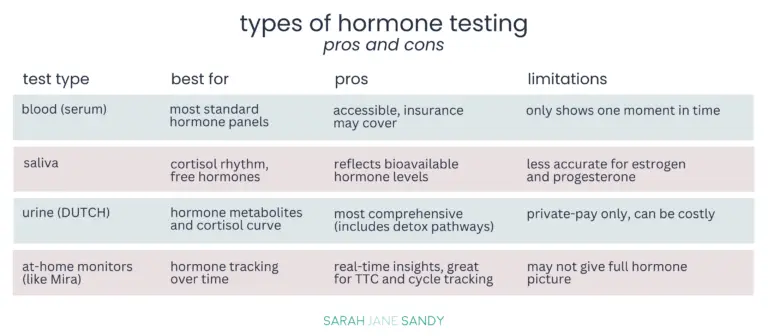
Hormone levels fluctuate throughout your cycle — so when you test matters just as much as what you test.
Here’s a general guide:
This is when you want to check baseline reproductive hormone levels.
These tests are helpful for understanding egg quality, thyroid function, or why your cycle might be irregular or delayed.
This is peak progesterone time (your luteal phase). Test:
These tests are helpful for confirming ovulation, identifying low progesterone, identifying fertility challenges, reducing PMS, or why your cycle might be irregular or delayed. If your cycle is longer or shorter than 28 days, adjust your test date to about 7 days post-ovulation or if you don’t know when you ovulate, plan to test 7 days before your next expected period is set to start — that’s your luteal phase sweet spot.
Some markers aren’t cycle-dependent and can be tested any day:
✔ Are you ovulating? (Check progesterone)
✔ Do you have estrogen dominance? (Check E2 vs. progesterone ratio)
✔ Is stress burning you out? (Check cortisol + DHEA)
✔ Could thyroid issues be at play? (Check TSH, T3, T4, antibodies)
✔ Are androgens (like testosterone) too high? (Helpful for PCOS, acne, hair issues)
✔ Is your liver clearing hormones well? (DUTCH shows estrogen detox pathways)

Here’s what I see constantly in my practice: a woman comes to me with irregular cycles, brutal PMS, spotting before her period, and trouble conceiving. She’s had labs run. She’s been told everything looks normal.
But her progesterone was checked on day 21 of a 33-day cycle, which means it was drawn nowhere near her actual luteal peak. Or her thyroid panel only included TSH, with no free T3, free T4, or antibodies. Or nobody tested at all, because her cycle ‘comes every month.’
Your cycle can be telling you something your lab report isn’t capturing, simply because the wrong things were measured at the wrong time.
That’s not a normal cycle. That’s an uninvestigated one.
It’s rarely unexplained. It’s uninvestigated.
We’ve been taught to dread our period, medicate the symptoms, and move on — but your cycle is a vital sign. It’s your body’s way of saying “Hey girl, here’s what’s going on.”
When you learn how to listen to the messages of your body, you can:
You are not broken, lazy, or crazy. You are cyclical. And that’s powerful.
If you’re trying to get pregnant and looking for a solution-based, comprehensive approach, read my complete guide: What’s Actually Preventing Pregnancy — and How to Fix It.
Is it normal to miss a period?
What Your Period Says About Your Health
Using Bioidentical Progesterone to Naturally Increase Progesterone Levels
Balanced Living With Hormone Imbalance: Estrogen Dominance
Balanced Living With Hormone Imbalance: Low Progesterone
Your cycle is giving you information. The Fertility Code helps you understand what it means and what to do about it.
The Fertility Code is my 12-week, high-touch fertility program designed to identify the hidden drivers preventing pregnancy and correct them with a strategic, personalized plan, so you can get pregnant naturally or through IVF.
Whether you’ve been told everything looks ‘normal’ or you’re managing a diagnosis like PCOS or endometriosis, we test properly, interpret your results in context, and build a plan around your specific physiology.
More than 90% of the women who complete The Fertility Code go on to conceive.
Stop guessing. Start getting answers.



© 2026 Sarah Jane Sandy. All rights reserved. Privacy Policy | Terms and Conditions | Medical Disclaimer | Editorial Policy

Curious about your fertility health? Take this simple quiz to find out what factors may be harming your fertility, and learn what you can do about it!